
The Solar System formed at least 4.568 billion years ago from the gravitational collapse of a region within a large . This initial cloud was likely several light-years across and probably birthed several stars. As is typical of molecular clouds, this one consisted mostly of hydrogen, with some helium, and small amounts of heavier elements by previous generations of stars.
Contact online >>
The IRS has published guidelines that list the useful life of solar panels as 20 years. Once you have the cost and useful life, you can calculate the depreciation using a standard formula. The depreciation of solar panels can be a valuable tax deduction for homeowners who install them on their property.
Contact online >>
Deep cycle batterieslook similar to car batteries, but are actually very different. In contrast to car batteries which only provide short bursts of energy, deep cycle batteries are designed to provide sustained perio. . Not every solar power setup needs battery storage. If you’re grid-tied, there’s no. . There’s a range of deep cycle battery options.The most common ones used for solar installations are flooded lead acid, sealed lead acid, and lithium iron batteries. Flooded le.
Contact online >>
The Integrated Solar Combined Cycle Power Plant (ISCC) has been introduced in the power generation sector as a technology with the potential to help reduce the costs of solar energy for elec-tricity generation. An ISCC power plant combines a Concentrated Solar Power (CSP) plant and a Natural Gas-Fired Combined Cycle (NGCC) power plant.
Contact online >>
A battery energy storage system (BESS) or battery storage power station is a type of technology that uses a group of to store . Battery storage is the fastest responding on , and it is used to stabilise those grids, as battery storage can transition from standby to full power in under a second to deal with .
Contact online >>
Most of the BESS systems are composed of securely sealed , which are electronically monitored and replaced once their performance falls below a given threshold. Batteries suffer from cycle ageing, or deterioration caused by charge-discharge cycles. This deterioration is generally higher at and higher . This aging cause a loss of performance (capacity or voltage decrease), overheating, and may eventually le.
Contact online >>
The battery life of energy storage depends on the storage duration and usage cycles123:Storage duration: Most commercially deployed battery energy storage systems have storage durations of two to four hours2.Battery lifespan: Batteries can last anywhere between 5-15 years, with replacement likely needed during the 20-30 year life of a solar system3.
Contact online >>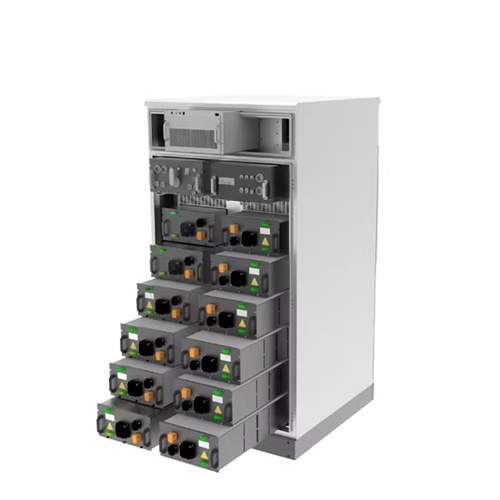
Generally, the negative electrode of a conventional lithium-ion cell is made from . The positive electrode is typically a metal or phosphate. The is a in an . The negative electrode (which is the when the cell is discharging) and the positive electrode (which is the when discharging) are prevented from shorting by a separator. The el.
Contact online >>
A code repository is necessary to increase awareness and improve safety in the energy storage industry. Electrochemical energy storage has a reputation for concerns regarding the ventilation of hazardous gases, poor reliability, short product life, substantial cooling requirements, and high levels of periodic maintenance.
Contact online >>
As renewable power and energy storage industries work to optimize utilization and lifecycle value of battery energy storage, life predictive modeling becomes increasingly important. Typically, end-of-life (EOL) is defined when the battery degrades to a point where only 70-80% of beginning-of-life (BOL) capacity is remaining under nameplate
Contact online >>Enter your inquiry details, We will reply you in 24 hours.

